

20 May What Is a Wound Care APRN vs a Podiatrist?
When you are facing a stubborn wound, a diabetic foot complication, or chronic lower-leg issues, understanding the difference between an APRN vs podiatrist can completely change the kind of care you receive and how quickly you heal.
Many patients in Muskogee, OK, assume these two providers do the same job, but in reality, they bring very different training, philosophies, and treatment approaches to the table. One specializes in the structural and surgical side of the foot and ankle, while the other focuses on advanced nursing-led care, wound healing, prevention, and whole-person wellness.
Knowing which kind of provider fits your needs is one of the most underrated decisions in chronic wound and diabetic foot care, and it can be the difference between a wound that heals quickly and one that drags on for months. This guide breaks down both roles clearly so you can make an informed choice for yourself or a loved one.
APRN vs Podiatrist: The Core Difference Explained
The fundamental difference between an APRN and a podiatrist starts with their education and clinical philosophy. A podiatrist, or Doctor of Podiatric Medicine (DPM), completes four years of podiatric medical school followed by a three-year hospital-based residency focused specifically on the foot, ankle, and related lower-extremity structures. Their training is heavily oriented toward biomechanics, foot and ankle surgery, structural deformities, fractures, and reconstructive procedures. When you see a podiatrist, you are seeing a provider whose entire scope of practice centers on one anatomical region, often with a strong surgical emphasis.
An Advanced Practice Registered Nurse, or APRN, particularly one specializing in wound care, comes from a fundamentally different background. APRNs are registered nurses who have earned advanced degrees, typically a Master of Science in Nursing or a Doctor of Nursing Practice, and have years of bedside clinical experience before moving into advanced practice.
A wound care APRN, especially a Clinical Nurse Specialist with specialized wound certification, brings deep expertise in wound physiology, infection control, dressing selection, debridement, nutrition’s role in healing, pressure redistribution, and the holistic management of chronic wounds. Their philosophy roots itself in nursing science, which emphasizes prevention, patient education, the relationship between mind and body, and the integration of medical care with everyday lifestyle.
The simplest way to think about it is this: a podiatrist is often the right call when the problem is primarily structural, surgical, or orthopedic, while a wound care APRN is often the right call when the problem is primarily a wound that will not heal, a diabetic foot at risk, or a chronic skin and tissue issue that needs ongoing, conservative, prevention-focused management. If you have a wound that has not healed in weeks or are worried about your diabetic feet, do not wait.
What a Wound Care APRN Does Differently
Wound care APRNs spend most of their clinical time on what most other providers consider the unglamorous middle of healthcare, the chronic, slow-healing, complicated wounds that need someone who will actually sit with the patient, assess the whole picture, and adjust the plan weekly.
This includes diabetic foot ulcers, venous leg ulcers, arterial wounds, pressure injuries, surgical wounds that have reopened, chronic skin tears, and complex non-healing wounds of all kinds. The APRN’s approach is intentionally evidence-based and relationship-driven, meaning they prioritize understanding why a wound is not healing rather than just treating what is visible.
In a typical wound care APRN visit, you will receive a comprehensive evaluation that goes well beyond looking at the wound. The provider examines circulation, sensation, nutrition status, blood sugar control, medications, footwear, daily activities, support systems at home, and your overall risk profile.
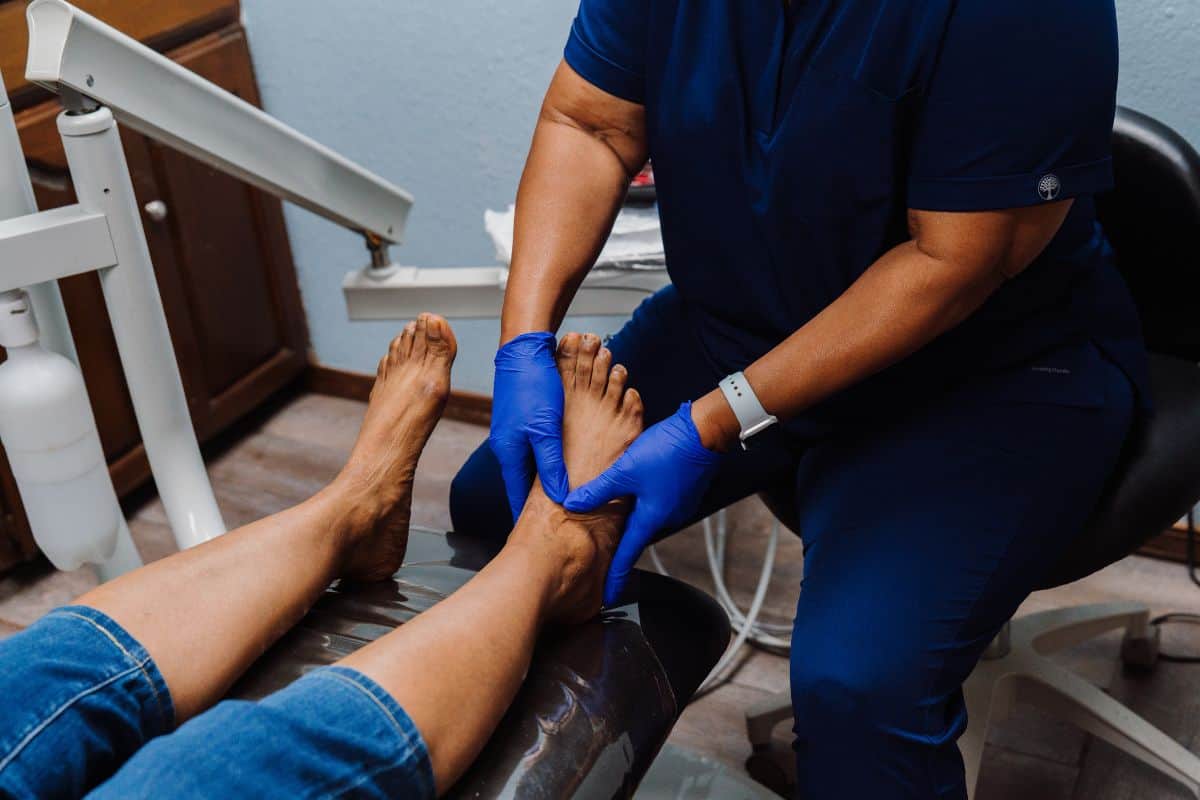
They perform conservative sharp debridement when needed, select advanced dressings tailored to the wound’s specific phase of healing, promptly address infection, manage moisture balance, and offload pressure with appropriate devices. Just as importantly, they teach you and your family how to participate in your own healing, which is often what separates a wound that closes from one that returns.
APRNs also tend to spend more time per visit than surgical specialists, simply because the nature of wound care requires it. Healing is rarely about a single procedure; it is about consistent, attentive care over many weeks or months. This is where the nursing-based model genuinely shines.
If you’re still deciding between an APRN vs podiatrist, call Winds of Change in Muskogee to schedule your consultation with a specialized wound care APRN who can begin healing what others may have overlooked.
When a Podiatrist Is the Right Call, and When an APRN Is
Both providers serve essential roles, and the smartest patients use both when appropriate. A podiatrist is the right primary provider when you have a foot or ankle fracture, a significant biomechanical issue, a bunion or hammertoe requiring surgical correction, severe Charcot foot needing reconstruction, plantar fasciitis that has not responded to conservative care, or any condition where surgery is clearly indicated. Podiatrists are also valuable for ordering custom orthotics, addressing structural deformities, and performing nail or skin procedures that fall within their surgical scope.
A wound care APRN is the right primary provider when you have a chronic wound that is not healing, a diabetic foot ulcer in any stage, recurring infections in the foot or lower leg, neuropathy that has you worried about prevention, thickened or fungal nails that need medical-grade care without a surgical context, or any situation where you want a prevention-first, conservative, education-rich approach. APRNs are also ideal for patients who feel overwhelmed by the medical system and need a provider who will actually explain things, listen, and partner with them.
In many cases, the best care plan involves both, with the APRN managing the day-to-day wound-healing and prevention work, and a podiatrist consulting on structural or surgical concerns as they arise. Good providers communicate with each other, and good patients benefit from that collaboration.
Why Choose Winds of Change
Winds of Change in Muskogee, OK, was founded by Lynette Gunn, a Clinical Nurse Specialist with more than two decades of experience in wound and foot care, including many years leading wound services at the Jack C. Montgomery VA Medical Center. As a wound care APRN-led practice, we offer something genuinely rare: highly specialized, prevention-focused, non-surgical lower extremity care delivered by a provider who has spent her entire career mastering this work.
We provide comprehensive wound assessments, advanced dressing and debridement protocols, diabetic foot care, medical-grade nail and callus care, neuropathy support, and patient education that empowers you to protect your feet long after you leave our office. We serve patients across Muskogee, Ft Gibson, Tulsa, Broken Arrow, Okmulgee, and the surrounding communities, and we offer medical transportation and flexible financing so that no one has to choose between their feet and their finances. The trust we have built with physicians, surgeons, and patients alike comes from a single principle: we treat every wound and every foot as if it were our own.
Conclusion
Choosing between a wound care APRN and a podiatrist is about picking the right provider for your specific situation. Podiatrists excel at the structural, surgical, and orthopedic side of foot and ankle care.
In contrast, wound care APRNs excel at the slow, careful, relationship-based work of helping chronic wounds heal and at-risk feet stay safe. For patients with diabetic foot concerns, non-healing wounds, neuropathy, or anyone seeking a prevention-first approach, an APRN-led practice often provides exactly the kind of attentive, holistic care that produces lasting results.
The team at Winds of Change in Muskogee is here to walk that journey with you, bringing decades of specialized expertise to the wounds and feet that need it most. Healing is rarely fast, but with the right provider in your corner, it is almost always possible.
Still weighing APRN vs podiatrist for your wound or diabetic foot care? Schedule your consultation with Winds of Change today and experience the difference the right provider can make.
Frequently Asked Questions
Can a wound care APRN actually treat wounds as effectively as a doctor?
Yes, absolutely. Wound care APRNs hold advanced degrees, often have specialized wound care certifications, and frequently have more focused training and clinical experience in chronic wound management than many physicians. Studies consistently show that APRN-led wound care produces outcomes comparable to and sometimes better than physician-only models, especially in chronic and diabetic wound populations.
Do I need a referral to see a wound care APRN?
Referral requirements depend on your insurance plan and state regulations rather than on the APRN’s qualifications. Some insurance plans require a primary care referral for any specialist visit, while others allow patients to self-refer. Always call your insurance provider directly to confirm what they require before you schedule your first appointment.
Does insurance cover visits to a wound care APRN?
Most major insurance plans, including Medicare and Medicaid, cover medically necessary wound care services delivered by an APRN. Coverage details, copays, and visit limits vary by plan and by the specific services provided, so it is always smart to call your insurance company in advance and ask about coverage for wound care, debridement, and supplies.
How often will I need to come in for wound care visits?
Visit frequency depends on the type, size, and complexity of your wound. Active chronic wounds typically require weekly visits, while stable wounds or maintenance care may need only every two to four weeks. Once a wound has healed, your provider will schedule follow-up visits for prevention and monitoring monthly, quarterly, or annually based on your individual risk level.
Can a wound care APRN write prescriptions?
In most states, including Oklahoma, APRNs have prescriptive authority and can prescribe medications, including antibiotics, pain medication, and specialized wound care products. The exact scope of prescriptive authority varies by state, but APRNs are fully credentialed to manage the medical aspects of wound healing, including pharmacologic therapy.
Sorry, the comment form is closed at this time.