

14 Sep What Jobs Can I Get With a Wound Care Certification?
A home health nurse in Muskogee, Oklahoma has spent six years changing dressings on diabetic foot ulcers and pressure injuries, and she is now asking what jobs can I get with a wound care certification before she commits to a specialty move. That question comes up constantly among LPNs and RNs who already do wound-adjacent work every shift, whether that is a med-surg nurse managing post-surgical incisions or a long-term care nurse tracking a resident’s stage 2 pressure injury. The honest answer is that a wound care credential does not lock you into one job title. It opens the door to several different practice settings, each with its own pace, patient population, and schedule.
Before looking at those settings, it helps to know what the credential itself requires. The Wound Treatment Associate Certified (WTA-C) credential is open to both LPNs and RNs, with no bachelor’s degree required, which is different from the CWCN credential that requires an RN license plus a bachelor’s degree. That distinction matters because it changes which roles are realistically available to you right after you get certified, and it is confirmed directly on the WTA-C eligibility page from the certifying board.
What Jobs Can I Get With a Wound Care Certification in These Five Settings?
Wound-certified nurses tend to land in a handful of recurring settings rather than one narrow job description. These are the ones that come up most often for LPNs and RNs who complete a wound care credential:
- Hospital wound care and consult teams, where a certified nurse assesses and treats post-surgical wounds, pressure injuries, and complex acute cases across multiple units instead of one assigned floor.
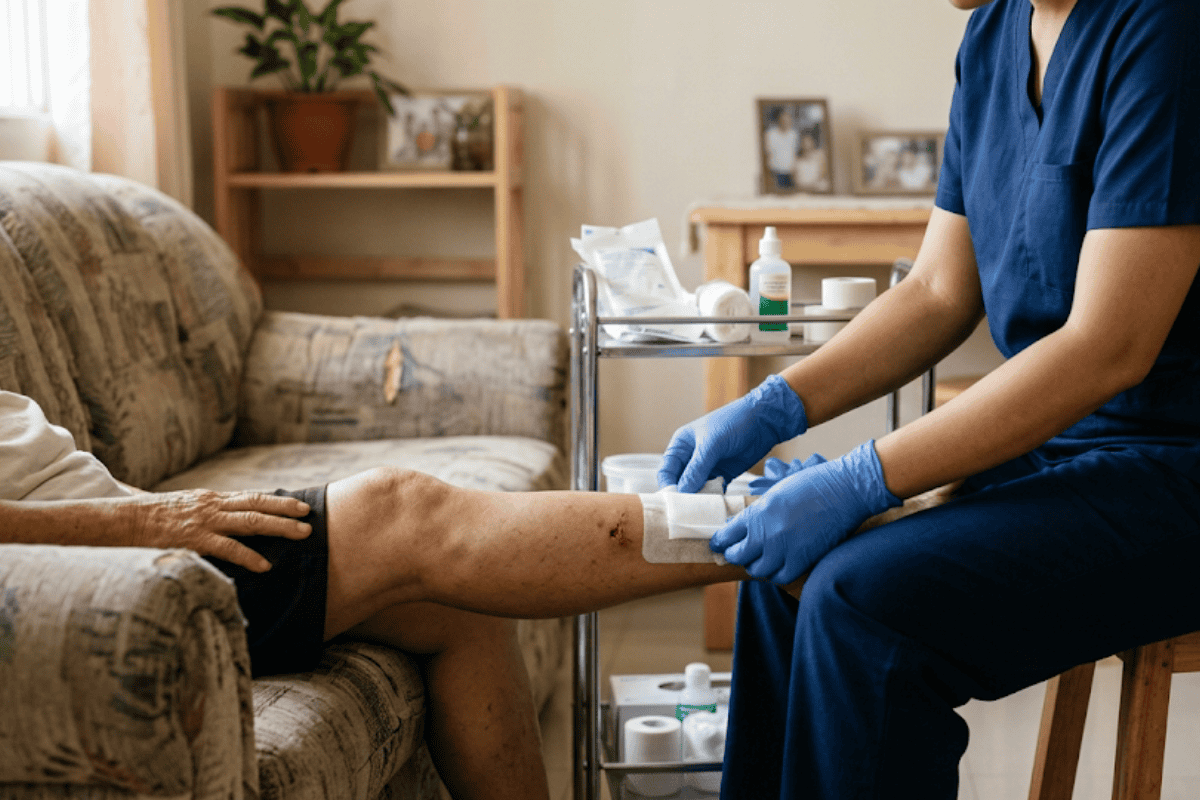
- Home health and in-home patient care agencies, where the nurse travels to the patient’s residence to manage diabetic foot ulcers and other chronic wounds in the home, the setting closest to how Winds of Change delivers its own Direct Patient Care.
- Long-term care and skilled nursing facility wound consulting, often a regional role covering several facilities with a focus on pressure injury prevention, staff training, and documentation review.
- Outpatient wound clinics, appointment-based settings where the same patients are followed over weeks or months for chronic wounds like venous ulcers.
- Per diem and travel wound care consulting, short-term or contract assignments that let a certified nurse cover multiple facilities or regions, similar to other travel nursing specialties.
Hospitals remain the single largest employer of nurses generally, a pattern confirmed by job outlook data from the Bureau of Labor Statistics, and that scale is part of why hospital consult teams are such a common landing spot for a newly certified wound nurse. But the other four settings are not fallback options. Home health agencies specifically hire certified clinicians to supervise field staff and manage visit-based wound caseloads, and long-term care facilities frequently create regional wound consultant roles precisely because pressure injury prevention carries real financial and regulatory weight for the facility.
Here is how those five settings compare on caseload focus, since the day-to-day work looks different depending on where you land.
| Job Setting | Typical Caseload Focus | Common Work Pattern |
|---|---|---|
| Hospital consult team | Post-surgical wounds, pressure injuries, complex acute cases | Covers multiple units, not one assigned floor |
| Home health / in-home agency | Diabetic foot ulcers and chronic wounds managed in the home | Visit-based, travels to the patient |
| SNF / long-term care | Pressure injury prevention, staff training | Often regional, spans several facilities |
| Outpatient wound clinic | Chronic wounds followed over weeks to months | Appointment-based, repeat patients |
| Per diem / travel | Short-term coverage across multiple facilities | Contract-based, variable location |
Ready to Explore the WTA Program? Contact Us for a Free Consultation
Why Choose Winds of Change
Winds of Change already runs a Direct Patient Care service line that handles real, non-surgical diabetic foot and wound care cases across Muskogee, Fort Gibson, Tulsa, Broken Arrow, and Okmulgee. That matters for anyone asking what jobs can I get with a wound care certification, because trainees in the WTA program get their individualized clinical hours exposed to that same active caseload, not a simulated lab scenario built for a classroom. A student working toward the WTA-C credential through this program is doing dressing changes, wound assessments, and care coordination on patients the agency is already treating in their homes, which maps directly onto the home health and in-home agency settings covered above and gives a very concrete sense of what that job actually involves before you ever apply for one.
The program itself is a blended format: online didactic coursework, a weekend in-office skills lab, individualized clinical hours, and mentoring, completed over 3 to 4 months. It is open to both RNs and LPNs, and no bachelor’s degree is required, which is one reason the Winds of Change program is a realistic entry point for LPNs who want the settings described above without first returning to school for a BSN. The program is directed by Lynette Gunn, APRN, CWCN, CFCN. Pricing is not published here; reach out for a free consultation to get current program cost and start dates.
How Certification Actually Affects Your Job Search
It is worth being direct about what a wound care credential does and does not do for your career. The research on this is fairly consistent: certification has a stronger, better-documented effect on getting hired than it does on pay. A survey covering hiring preference found that a large majority of nurse managers said they would choose a certified nurse over a non-certified one when other factors were equal, and that pattern holds in wound care specifically. Facilities that carry heavy wound and pressure injury caseloads have a direct incentive to hire someone who already has the credential, because it reduces onboarding and audit risk. Certification can also lead to more job opportunities simply because fewer applicants hold the credential than hold a general nursing license, which narrows the competitive field in your favor. What the data does not support is a guaranteed, specific pay bump tied directly to the certification itself; any pay increase tends to follow from moving into a different role or setting, not from the credential in isolation.
Getting Started From Muskogee, Oklahoma
If you are already working in Muskogee, Fort Gibson, Tulsa, Broken Arrow, or Okmulgee, the practical next step is figuring out which of the five settings fits your current schedule and license type. An LPN who wants to stay in direct patient care without pursuing a BSN will find home health and SNF wound consulting the most immediately accessible, since both commonly work with WTA-C-credentialed LPNs. An RN who already holds or is willing to pursue a bachelor’s degree has a wider set of options, including hospital consult teams and outpatient clinics that often prefer the CWCN credential. Either way, the fastest way to sort out which path lines up with your license, schedule, and goals is a direct conversation rather than trying to piece it together from job postings alone.
Conclusion
The question of what jobs can I get with a wound care certification usually has a more specific answer than people expect: hospital consult teams, home health and in-home agencies, long-term care and SNF consulting, outpatient wound clinics, and per diem or travel work are the settings where certified LPNs and RNs actually land. Which one fits you depends on your license, your schedule, and how much hands-on patient contact you want day to day. For nurses in Muskogee, Fort Gibson, Tulsa, Broken Arrow, or Okmulgee who are ready to find out which path matches their situation, a direct conversation is the fastest way to get a real answer.
Have Questions About Your Next Step? Contact Winds of Change Today
Frequently Asked Questions
What jobs can I get with a wound care certification?
Certified nurses commonly work on hospital wound care and consult teams, in home health and in-home patient care agencies, in long-term care and skilled nursing facility wound consulting roles, in outpatient wound clinics, and in per diem or travel wound care consulting. Which of these is realistic for you depends partly on whether you hold an LPN or RN license and which credential you pursue.
Can LPNs get wound care certification jobs?
Yes. The WTA-C credential is open to both LPNs and RNs and does not require a bachelor’s degree, so LPNs can qualify for many home health, long-term care, and outpatient wound care roles. Some hospital and specialist positions prefer the CWCN credential, which does require an RN license and a bachelor’s degree.
Is wound care nursing a good career choice?
It can be, particularly for nurses who already enjoy hands-on procedural work and want more autonomy than a typical floor assignment. The field offers several distinct practice settings, from bedside consult work to home-based care, so nurses can often find a version of the role that fits their preferred pace and patient population.
Do wound care certified nurses travel for work?
Some do. Per diem and travel wound care consulting is a recognized path within the specialty, letting certified nurses take short-term or contract assignments across multiple facilities or regions. Home health wound care is also travel-based, though typically within one local service area rather than across the country.
Does a wound care certification guarantee higher pay?
Not on its own. Research shows certification has a stronger, more consistent effect on hiring preference and job competitiveness than on pay specifically. Any salary increase more often comes from moving into a new role or setting after certification rather than from the credential itself.
Sorry, the comment form is closed at this time.