

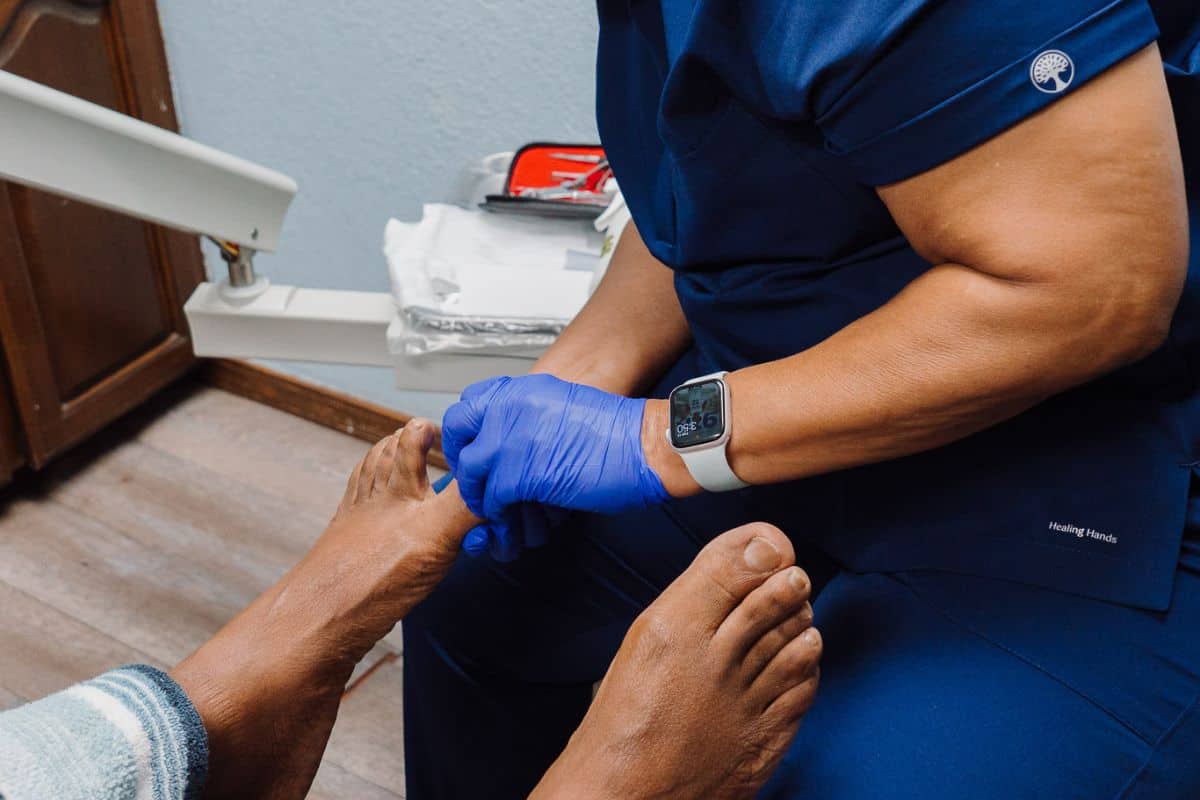
09 Apr Do I Need a Podiatrist or a Wound Care Specialist?
If you have been searching podiatrist vs wound care Muskogee and feel unsure which direction to take, you are not alone — this is one of the most common questions patients ask when they are dealing with foot pain, a slow-healing sore, or complications from diabetes.
Both types of providers serve important roles, but they are not interchangeable. Choosing the wrong one can cost you precious time, especially when a wound is involved.
This guide will walk you through the differences between a podiatrist and a wound care specialist, help you decide which you truly need, and explain why patients across Muskogee, OK, are turning to Winds of Change for expert, compassionate lower extremity care.
What Does a Podiatrist Do?
A podiatrist is a Doctor of Podiatric Medicine (DPM) who specializes in the diagnosis and surgical or medical treatment of conditions affecting the foot, ankle, and lower leg. They completed four years of podiatric medical school followed by a residency program.
Podiatrists are best suited for:
- Structural foot problems such as bunions, hammertoes, and flat feet
- Fractures, sprains, and sports-related ankle injuries
- Ingrown toenails requiring surgical correction
- Plantar fasciitis and heel pain management
- Orthotics prescriptions and fitting
- Surgical repair of tendons, bones, and ligaments in the foot and ankle
If your concern is primarily mechanical, orthopedic, or surgical, a podiatrist is your starting point.
What Does a Wound Care Specialist Do?
A wound care specialist focuses on the assessment, treatment, and management of chronic, complex, or slow-healing wounds. This specialty often draws from nursing, advanced practice nursing, or physician backgrounds with dedicated training in wound care science.
Wound care specialists are best suited for:
- Diabetic foot ulcers and pressure wounds
- Venous and arterial leg ulcers
- Post-surgical wounds that are not closing properly
- Infected wounds requiring ongoing debridement and dressing management
- Wounds complicated by neuropathy, poor circulation, or compromised immunity
- Patient education on wound prevention and skin integrity
If your concern involves an open wound, a sore that refuses to heal, or a lesion related to a systemic condition like diabetes, a wound care specialist is your frontline provider.
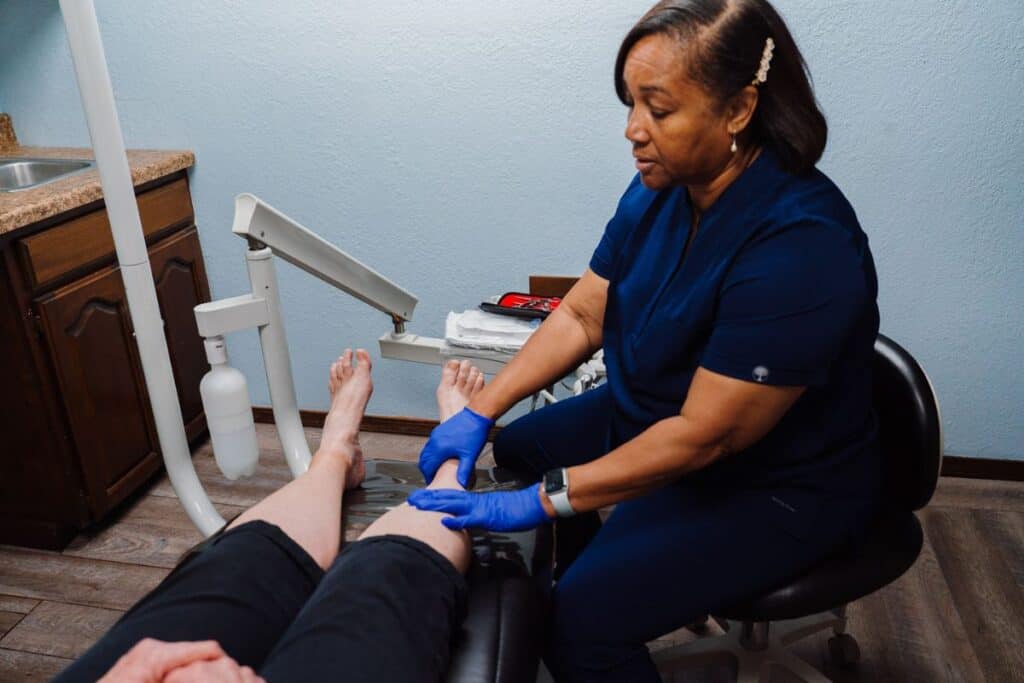
Podiatrist vs Wound Care Muskogee: Understanding the Key Differences
Here is a simple breakdown to help clarify the difference:
Podiatrist
- Focuses on structure, mechanics, and surgery
- Treats bones, joints, tendons, and nails
- Performs surgical procedures
- Sees patients for a wide range of foot and ankle issues
Wound Care Specialist
- Focuses on tissue repair and chronic wound management
- Treats open wounds, ulcers, and compromised skin
- Non-surgical, evidence-based wound treatment
- Specializes in diabetic, vascular, and neuropathic wounds
Both providers can collaborate on a patient’s care but if you are living with diabetes and you notice a sore on your foot, do not wait for a surgical consult. A wound care specialist can intervene early and help you avoid surgery altogether.
Ready to get expert wound care before things get worse? Call Winds of Change today or visit our website to schedule your consultation in Muskogee, OK.
When Should You See a Wound Care Specialist First?
Many patients make the mistake of waiting too long before seeking specialized wound care. Here are signs that you should contact a wound care specialist immediately rather than scheduling a general podiatry appointment:
- A sore or blister on your foot that has not healed in two weeks or more
- Redness, warmth, swelling, or discharge around a wound
- A wound that appears to be growing larger instead of smaller
- Odor coming from a wound site
- Loss of sensation in your feet due to diabetic neuropathy
- Dark or discolored skin around the wound edges
- A physician has told you that you are at risk for amputation
If any of these apply to you, every day matters. Chronic wounds that go untreated can lead to deep tissue infections, bone involvement (osteomyelitis), and in serious cases, limb loss. Do not wait.
The Role of Diabetic Foot Care in Wound Prevention
Diabetes is one of the leading causes of chronic wounds, particularly on the feet and lower legs. Here is why people with diabetes are at such high risk:
- Neuropathy: High blood sugar damages nerves over time, reducing sensation in the feet. You may step on something sharp or develop a blister without even feeling it.
- Poor circulation: Diabetes narrows blood vessels, limiting the delivery of oxygen and nutrients that wounds need to heal.
- Immune suppression: Elevated glucose levels impair the body’s ability to fight infection.
- Delayed healing: All of the above factors combine to slow the natural healing process dramatically.
This is why routine diabetic foot care is not a luxury — it is a medical necessity. Regular professional assessments, medical-grade nail care, and early identification of problem areas can prevent a small callous from becoming a life-threatening wound.
Why Medical-Grade Nail Care Matters More Than You Think
One of the most underestimated risks in lower extremity health is improper nail care. For someone with diabetes, neuropathy, or compromised circulation, a simple ingrown nail or a thick fungal nail can become a serious entry point for infection.
Medical-grade nail care performed by a trained specialist includes:
- Safe trimming and debridement of thickened or fungal nails
- Assessment of the surrounding tissue for early signs of infection
- Monitoring changes in nail color, texture, or growth patterns
- Education on proper home care between visits
Winds of Change provides this service with clinical precision, treating every visit as an opportunity to catch problems before they escalate.
Why Choose Winds of Change for Wound Care in Muskogee
Winds of Change is not a typical clinic. Founded by Lynette Gunn, a Clinical Nurse Specialist with over two decades of experience including years at the Jack C. Montgomery VA Medical Center in Muskogee our practice is built on a foundation of evidence-based care, genuine compassion, and an unwavering commitment to keeping patients out of the operating room.
Here is what sets Winds of Change apart:
- Specialized Expertise — Lynette Gunn has spent over 20 years mastering complex wound care. She is not a generalist. Wound care is all she does, and she does it at the highest level.
- Non-Surgical Approach — Our philosophy is prevention first. We work hard to resolve wounds and prevent complications without surgery.
- Trusted by Physicians — Winds of Change has earned the trust of board-certified surgeons, including Dr. Michael Nolen, MD, FACS, and Dr. Carl W. Baker III, D.O., FACS, who have praised Lynette’s clinical outcomes and professionalism.
- Personalized Care — We take time with every patient. You are not a chart number here. We listen, assess, and create treatment plans tailored to your specific condition and lifestyle.
- Serving the Muskogee Community — We are locally rooted in Muskogee, OK, and proudly serve surrounding areas, including Ft Gibson, Tulsa, Broken Arrow, and Okmulgee.
- Comprehensive Services — Beyond wound care, we offer a Wellness Program, a Wound Treatment Associate (WTA) Training Program, and Medical Transport & Financing support to remove barriers to care.
When you walk through our doors, you are joining a community of patients who decided their health was worth fighting for.
Conclusion
The question of whether you need a podiatrist or a wound care specialist need not be confusing. If your issue is structural — think bones, joints, or mechanical pain a podiatrist is likely your first call. But if you are dealing with an open wound, a diabetic ulcer, a chronic sore, or any break in the skin that is not healing, a wound care specialist is who you need — and you need them now.
In Muskogee, Winds of Change is the trusted name in specialized wound care and diabetic foot health. With clinical excellence, deep community roots, and a patient-first philosophy, we are here to help you heal, stay mobile, and live your fullest life.
Do not wait until a small problem becomes a surgical emergency. Reach out today, and let us help you write a different story — one where you stay on your feet.
Frequently Asked Questions (FAQs)
1. Can a wound care specialist replace a podiatrist?
Not entirely. Wound care specialists and podiatrists serve different roles. A wound care specialist focuses on healing open wounds and managing chronic skin and tissue conditions, while a podiatrist handles structural and surgical foot issues. In many cases, the two work together. However, if your main concern is a non-healing wound, a wound care specialist is your priority.
2. How do I know if my foot wound is serious enough to see a specialist?
If a wound has not shown clear signs of improvement within two weeks, is growing in size, shows redness or discharge, or you have diabetes or poor circulation, it is serious enough to see a specialist right away. Do not wait to see if it heals on its own.
3. Does Winds of Change accept walk-ins?
Winds of Change operates by appointment to ensure every patient receives dedicated time and attention. You can schedule by calling (918) 351-1336. A $25 consultation fee applies, which is credited toward your treatment package.
4. What conditions does Winds of Change treat?
Winds of Change specializes in diabetic foot care, chronic wound management, medical-grade nail care, neuropathy-related foot concerns, venous and arterial ulcers, and lower leg and ankle conditions. They also offer a Wellness Program and Wound Treatment Associate training.
5. Is wound care covered by insurance?
Coverage varies depending on your insurance plan and the specific services rendered. It is recommended that you contact your insurance provider directly to verify your benefits. Winds of Change also offers Medical Transport & Financing options to help make care accessible for all patients.
Sorry, the comment form is closed at this time.